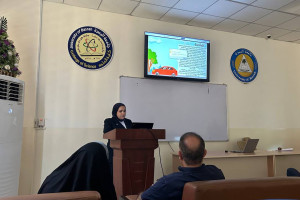
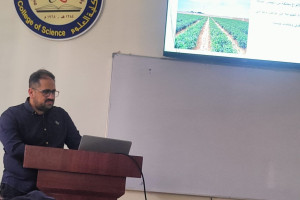
The Department of Earth Sciences at the College of Science discussed a master's thesis entitled "Mineralogical, Geochemical, and Petrophysical Analysis of the Zubair Formation in the Zubair Oil Field, Southern Iraq," submitted by researcher Rayan Hassan Ibrahim. The study aimed to understand the impact of mineral composition—particularly clay minerals—on reservoir rock performance, identify the most promising sandstone layers, and evaluate reservoir efficiency using well logs and laboratory analyses. The results showed that reservoir performance is primarily influenced by the lithological and mineral composition of the rocks. It was explained that the upper and lower sandstone organics possess the highest hydrocarbon potential due to the preservation of porosity and the dominant quartz framework. The presence of heavy, tar-like hydrocarbons was also observed, reflecting secondary metamorphic processes that may reduce extraction efficiency even in good sandstone layers. The study recommends focusing field development on quartz-rich sandstone layers with minimal smectite or mixed clay layers, avoiding clay-rich or tar-affected formations, and always supporting well log interpretation with mineralogical analysis before selecting extraction zones.
Important News


viewed most