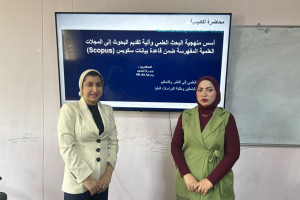
The Department of biology Sciences at the College of Science, University of Basrah, held an introductory scientific workshop on the European Academic Exchange Program (Erasmus+). This European Union initiative supports academic cooperation and exchange between European universities and institutions in partner countries, including Iraq.
The workshop provided an overview of the program and the procedures for participation. It highlighted the opportunities available to faculty members, students, postgraduate students, and administrative staff—enabling them to pursue studies, training, or academic exchanges at European universities for specified periods, with the option to return and continue their academic or professional careers at their home institution.
The session detailed the various participation options: faculty members may participate for five days (plus two days for travel); students may study for a full semester—ranging from five to twelve months; postgraduate students may conduct scientific research under the supervision of professors from European universities; and administrative staff may attend one-week training courses.
The workshop also showcased several European universities currently collaborating with Iraq, including Sapienza University of Rome (Italy), the University of Marburg (Germany), the University of Warsaw (Poland), and the University of Granada (Spain). It also highlighted the importance of the program in enhancing academic and research expertise, developing the participants' scholarly and professional profiles, and building international research networks that facilitate collaboration and joint scientific publication—in addition to the benefits associated with official academic secondment.
The workshop aimed to introduce department members and students to international academic exchange opportunities, encouraging them to take advantage of European scientific cooperation programs. This, in turn, contributes to the development of their scientific and research capabilities and fosters greater academic openness toward global universities.


Important News


viewed most