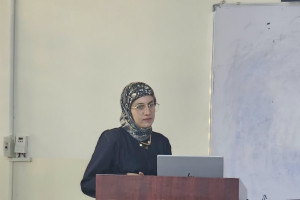
PhD thesis at Basraha University / College of science/Department of Biology to be discussed (( The bioactive Potential of Plant-Derrived Compounds Against Bacteria Responsible for Nosocomial infections in Healthcare Setting))
and showed the researcher's thesis (Rasha Hattab Abdullah) The evaluation of plant extracts obtained from several medicinal plants such as Moringa oleifera, Euphorbria tirucalli, Cynara cardunculus, and Artemisia herba-alba, These extracts were tested against a number of pathogenic bacterial isolates that are resistant to commonly used antibiotics and are associated with hospital infections. The bacterial species examined included Staphylococcus aureus, Klebsiella pneumoniae, Escherichia coli, E. coli, and Pseudomonas aeruginosa. In addition, the cytotoxic activity of the extracts was evaluated on the normal human cell line HBL100 and the liver cancer cell line HCAM.
The study aimed to isolate natural bioactive compounds from the selected plants and identify them using Gas Chromatography–Mass Spectrometry (GC-MS) analysis. Aqueous and organic extracts were prepared from the plant materials, and bacterial isolates were identified through morphological and biochemical characterization, including the API 20E system. The inhibitory effects of plant extracts on bacterial growth as well as their impact on both normal and cancer cell lines were also investigated.
The findings demonstrated that the plant leaf extracts exhibited significant antibacterial activity against the tested bacterial species, with the inhibitory effect increasing as the concentration of extracts increased. Among the plants studied, extracts of Cynara cardunculus showed the strongest inhibitory activity, followed by Moringa oleifera, while Euphorbria tirucalli extracts exhibited comparatively lower effects. Furthermore, aqueous and organic extracts of Cynara cardunculus and Artemisia herba-alba showed notable inhibitory activity against the normal cell line HBL100 and the liver cancer cell line HCAM.
The study recommends conducting further advanced chemical analyses to identify additional bioactive compounds from local plants and performing more extensive investigations on antibiotic-resistant bacterial isolates. It also suggests evaluating the effects of plant extracts on other cancer cell lines to better understand their potential therapeutic applications.
Important News

viewed most